
When Trauma Becomes Part of Everyday Life
When most people hear the term PTSD, they may think about a single traumatic event: a serious accident, an assault, military combat, a natural disaster, or another experience that left someone feeling unsafe. But trauma doesn’t always happen once. Sometimes it happens repeatedly, over months or years, and sometimes there is no easy way to escape the circumstances causing it.
This is where complex post-traumatic stress disorder, or C-PTSD, comes into the picture. PTSD and C-PTSD have a lot in common, but C-PTSD can develop in the context of prolonged or repeated trauma. It can affect not only how someone responds to memories of trauma, but also how they see themselves, regulate their emotions, relate to other people, and experience the world around them. For disabled people, that distinction can be particularly meaningful.
Disability itself does not cause C-PTSD. Being disabled is not inherently traumatic. But disabled people can experience repeated discrimination, exclusion, medical trauma, abuse, inaccessible environments, social isolation, and messages that they are less capable or less valuable than nondisabled people. When those experiences pile up over time, they can have a profound effect.
PTSD and C-PTSD: What’s the Difference?
PTSD can develop after someone experiences or witnesses something deeply frightening, threatening, or traumatic. The symptoms generally fall into several broad categories. Someone with PTSD may repeatedly experience the traumatic event through unwanted memories, nightmares, flashbacks, or intense emotional reactions. They may avoid people, places, conversations, or activities that remind them of what happened. They may also experience changes in their mood and thinking, such as persistent fear, guilt, shame, anger, or difficulty feeling positive emotions.
Another major part of PTSD is feeling constantly on guard. A person might startle easily, have trouble sleeping, feel irritable, or constantly scan their surroundings for danger.
C-PTSD can include all of these PTSD symptoms, but it also involves deeper, longer-lasting effects on a person’s sense of self and relationships. Someone experiencing C-PTSD may struggle with regulating their emotions. Their reactions may sometimes feel overwhelming or difficult to control. They may carry a deep sense of shame or worthlessness. They may have difficulty trusting people, forming relationships, setting boundaries, or feeling genuinely safe and connected to others.
In other words, PTSD can involve the feeling that something terrible happened to me. C-PTSD can add the feeling that something terrible happened to me for so long that it changed how I see myself and the world.
When the World Keeps Telling You That You Don’t Belong
For many disabled people, trauma isn’t necessarily one dramatic event. Sometimes it’s the accumulation of thousands of smaller experiences. It’s being talked down to by strangers, having someone speak to the person accompanying you instead of speaking directly to you, having your disability questioned or dismissed, or repeatedly being told that you’re “too young” to be disabled, that you “don’t look disabled,” or that you’re making too much of your needs. It’s having to explain and defend yourself over and over again.
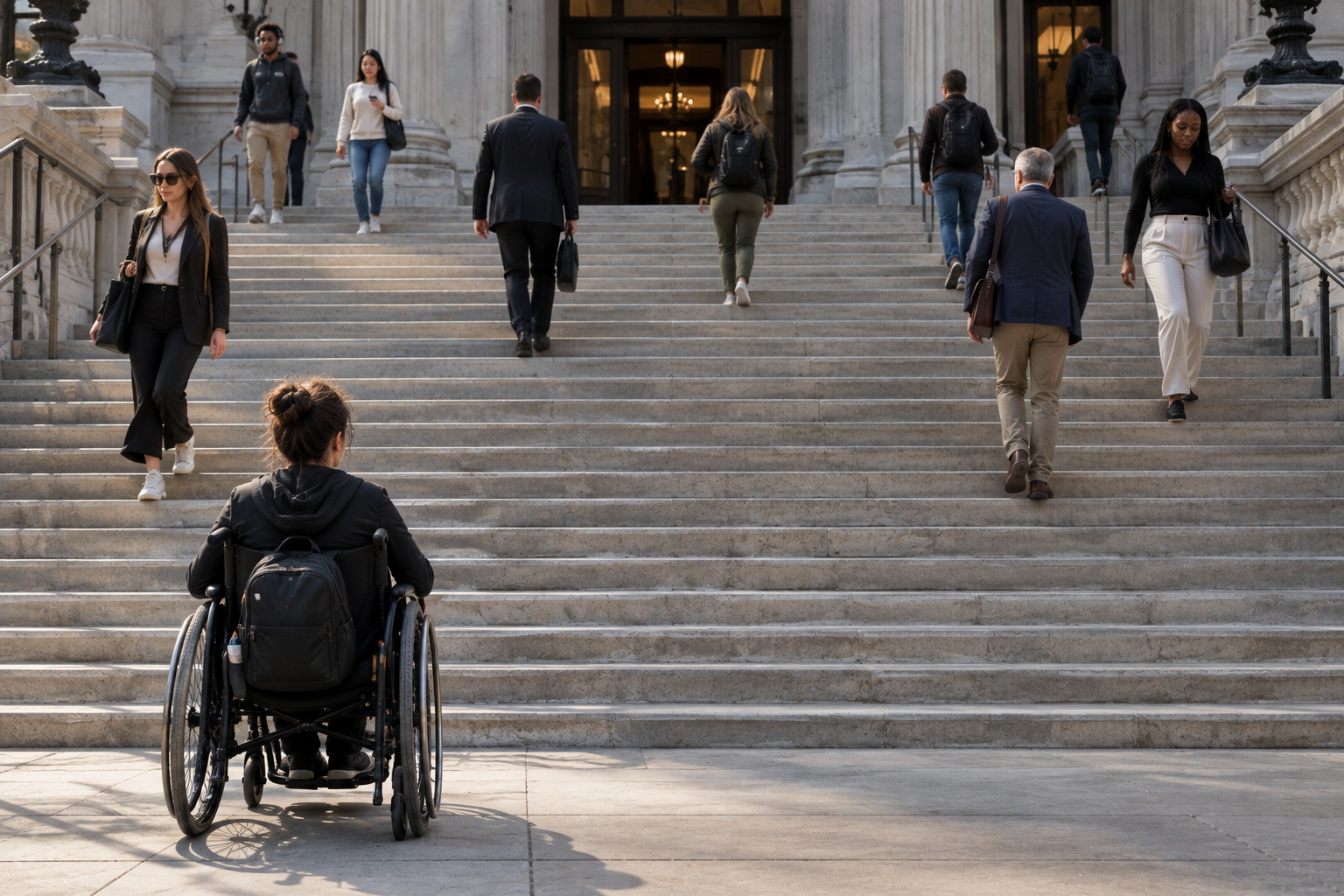
It’s also being excluded from places because they aren’t accessible. Accessibility problems aren’t just inconveniences when they happen repeatedly. Imagine being a wheelchair user and repeatedly arriving somewhere only to discover that there is no ramp or elevator. Imagine planning your day around whether a building has an accessible entrance, whether a bathroom can accommodate you, or whether transportation will actually be usable. Imagine being blind and navigating streets where sidewalks are poorly designed, crossings are dangerous, or the environment provides little reliable information about what is happening around you. Imagine having a sensory disability and repeatedly being expected to tolerate environments that overwhelm you because other people consider your needs inconvenient.
These experiences can create an ongoing sense that the world is not designed for you and that your safety, comfort, and participation are secondary concerns. When exclusion happens once, it can be frustrating. When it happens constantly, it can change how you experience the world.
The Damage of Being Othered
Disabled people are often treated as though they are fundamentally different from everyone else. Sometimes this is blatant, and sometimes it’s subtle. People may assume that a disabled person needs help without asking. They may assume someone can’t work, have relationships, raise children, live independently, make decisions, or pursue their goals. They may react with surprise when a disabled person does something completely ordinary.
There is another side to this, too: treating disabled people as inspirational simply for living their lives. A disabled person goes grocery shopping and someone acts as though they have accomplished something extraordinary. A disabled person gets a job and becomes a story about “overcoming adversity.” A disabled athlete, student, parent, or professional is presented primarily as an inspirational example rather than as a whole person.
This can sound positive, but it can still be dehumanizing. The underlying message can become: Your life exists to teach other people something. Disabled people don’t need to be inspirational simply for existing. They should be allowed to be ordinary human beings. They should be allowed to succeed, fail, struggle, rest, complain, have bad days, and pursue their goals without their disability becoming a lesson for everyone else.
Low Expectations Can Become Internalized
One of the most damaging things about constantly being underestimated is that eventually, you may start underestimating yourself. If you’re repeatedly told that something is too difficult for you, you may stop trying. If people constantly assume you need someone else to make decisions for you, you may begin questioning your own judgment. If you’re repeatedly treated as a burden, you may start believing that your needs are unreasonable.
This is one reason C-PTSD can involve such a complicated relationship with self-worth. The problem isn’t simply that other people have treated you badly. It’s that their messages can eventually become an internal voice. You may find yourself thinking:
- I’m too much.
- I’m a burden.
- Nobody wants to deal with me.
- I shouldn’t need this much help.
- I should be able to handle this.
- Maybe they’re right about me.
Healing means learning that those messages are not the truth.
Moving Toward Healing
Recovering from C-PTSD isn’t about forcing yourself to “get over” what happened. It’s also not about becoming so resilient that discrimination and exclusion stop hurting. Sometimes healing begins with something surprisingly simple: compassion for yourself.
Instead of asking, “What’s wrong with me?” try asking, “What happened to me, and how did it affect me?” Instead of criticizing yourself for needing accommodations, recognize that having needs does not make you weak or difficult. Instead of measuring your worth by productivity, independence, or what you accomplish despite your disability, begin recognizing that your worth exists independently of those things.
Building a stronger sense of self-worth can take time. It may mean discovering who you are outside of other people’s expectations. Your disability is part of your life, but it doesn’t have to define your entire identity.
Empowerment can also be an important part of healing. Learning your rights, asking for accommodations, setting boundaries, saying no, and advocating for yourself can help rebuild a sense of control. You don’t have to advocate every moment of every day, and you don’t have to fight every battle. Sometimes empowerment means choosing when to speak up, and sometimes it means choosing when to walk away and protect your energy.
Community matters, too. Being around people who understand your experiences without requiring you to constantly explain yourself can be incredibly healing. Disability communities can provide friendship, validation, humor, practical knowledge, and a sense of belonging that may have been missing elsewhere.
Professional mental-health support can also be valuable, particularly from someone who understands trauma and disability. You deserve a therapist who doesn’t treat your disability as the problem or assume that your goal should simply be to become more like a nondisabled person.
Ultimately, healing from C-PTSD isn’t about becoming unaffected by the world. It’s about learning that the things other people have said and done to you do not determine your worth. You are not a burden because you have needs. You are not less valuable because you need help. You do not have to inspire anyone. You do not have to prove that your life is worthwhile.
You are allowed to take up space. You are allowed to have boundaries. You are allowed to ask for what you need. You are allowed to be angry about injustice. You are allowed to rest. You are allowed to build a life that works for you.
And perhaps most importantly, you are allowed to see yourself as a whole person rather than as the collection of other people’s assumptions about disability. For someone living with C-PTSD, that realization can be an important part of coming home to yourself.
If you live in Washington State, and would like to set up an appointment with Susan Reimers, LICSW at Transcendent Mental Health, please click here.

