
DBT Skills, Therapy, Uncategorized

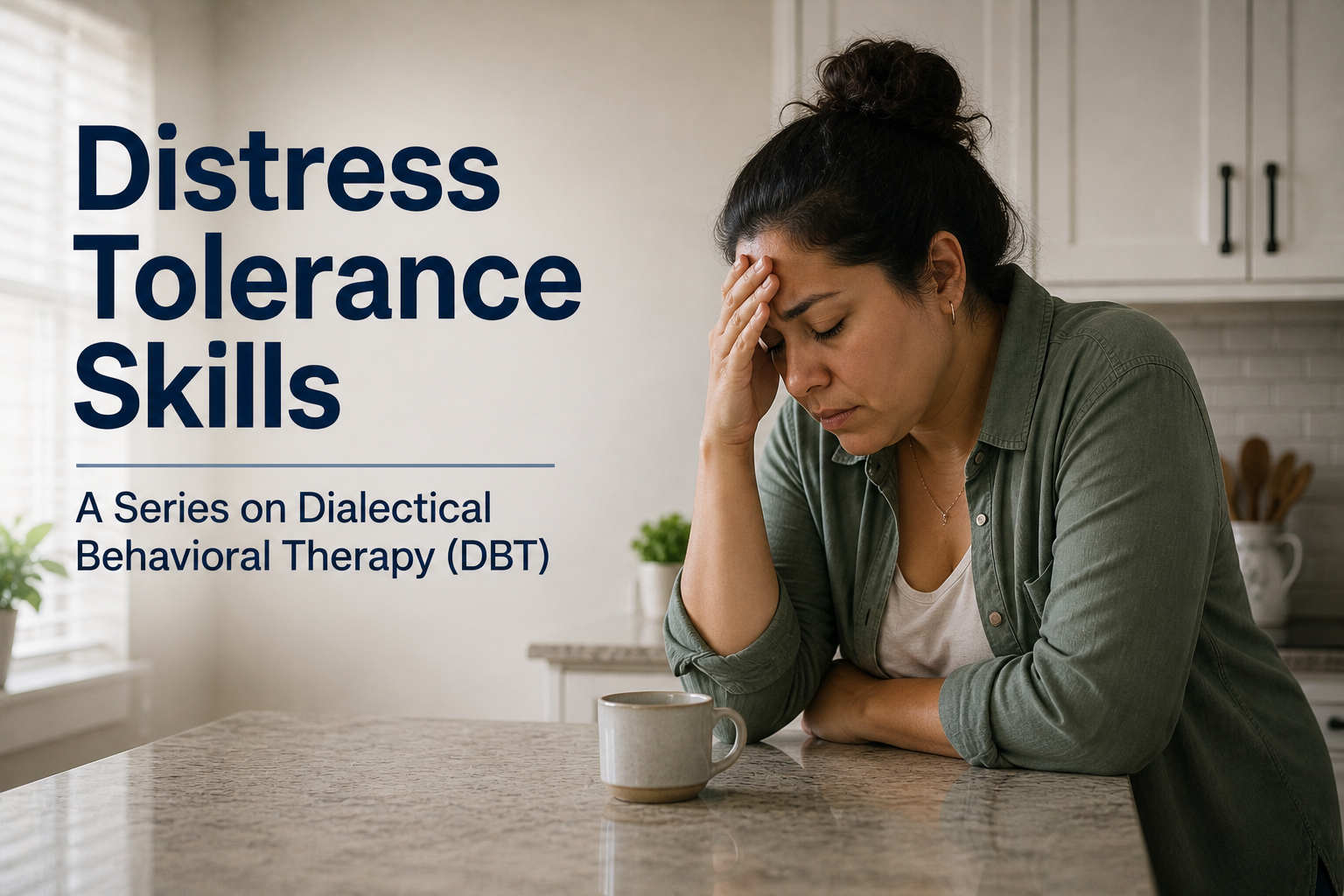
Distress Tolerance: Getting Through Difficult Moments Without Making Them Worse

Part 4 of a Five-Part Series on Dialectical Behavior Therapy

Sometimes a problem can be solved. Sometimes we can change how we think about it, negotiate with another person, make a different decision, or leave a situation that isn’t working.

And sometimes, at least for the moment, there is nothing we can do to make the problem go away.

A relationship ends. Someone we love becomes ill. We receive frightening news. We make a mistake that can’t be undone. Or perhaps we’re simply overwhelmed by an emotion that is too intense to work through right now.

These are the situations addressed by the Distress Tolerance skills of Dialectical Behavior Therapy (DBT).

The goal of distress tolerance isn’t to convince ourselves that a painful situation is okay. It is to survive a difficult moment without making it worse. When distress becomes intense, people sometimes turn to behaviors that provide immediate relief but create larger problems later—substance use, impulsive spending, self-harm, angry confrontations, reckless decisions, or other forms of escape.

Distress tolerance gives us alternatives.

When You Can’t Solve the Problem Right Now

Distress tolerance skills are especially useful during a crisis: a situation that is highly stressful, relatively short-term, and creates a strong urge to act.

If you can solve a problem effectively, DBT generally encourages you to solve it. Distress tolerance isn’t meant to become a way of avoiding necessary changes.

But timing matters. Trying to resolve a complicated relationship problem while you’re furious, for example, may make the situation worse. Sometimes the first task is simply getting through the next ten minutes, hour, or evening. Once the emotional intensity decreases, you can return to the problem with a clearer mind.

DBT offers several groups of skills for doing exactly that.

TIPP: Changing the Body to Calm the Mind

When emotional arousal becomes extremely intense, reasoning with ourselves may not be particularly effective. TIPP skills work more directly with the body’s physiological response.

TIPP stands for Temperature, Intense Exercise, Paced Breathing, and Paired Muscle Relaxation.

Changing body temperature—particularly cooling the face—can help reduce physiological arousal. Brief, vigorous exercise can provide an outlet for the physical energy associated with intense emotions. Paced breathing, particularly slowing the breath and extending the exhale, can help settle the nervous system. Paired muscle relaxation involves intentionally tightening and then relaxing muscles while noticing the difference between tension and relaxation.

These aren’t solutions to the underlying problem. They are ways of turning down the intensity enough to decide what to do next.

ACCEPTS: Getting Some Distance

Sometimes we need temporary distance from emotional pain. DBT uses the acronym ACCEPTS to describe several ways of redirecting attention: Activities, Contributing, Comparisons, Emotions, Pushing Away, Thoughts, and Sensations.

You might become absorbed in a movie, clean the kitchen, work on a hobby, help someone else, listen to music that produces a different emotion, do a puzzle, or focus on a strong but safe physical sensation.

The purpose isn’t permanent avoidance. It’s strategic distraction.

There is a big difference between refusing to deal with a problem and deciding, I am too overwhelmed to deal with this effectively right now. I’m going to give myself an hour and come back to it.

Self-Soothing and IMPROVE

DBT also teaches self-soothing through the five senses. We can intentionally seek comforting sights, sounds, smells, tastes, and physical sensations—a warm shower, comfortable clothing, calming music, a favorite tea, fresh air, or time in a peaceful environment.

Another group of skills is summarized by IMPROVE: Imagery, Meaning, Prayer, Relaxation, One thing in the moment, Vacation, and Encouragement. These practices help us change our relationship to a painful moment even when we can’t change the circumstances themselves.

A “vacation” in this context doesn’t mean flying to Hawaii whenever something goes wrong. It might mean deliberately giving yourself twenty minutes away from responsibilities. “One thing in the moment” means narrowing your attention to what is happening right now rather than mentally carrying every problem at once.

Radical Acceptance

Perhaps the most challenging—and most misunderstood—distress tolerance skill is Radical Acceptance.

Radical Acceptance means acknowledging reality completely, as it actually is, rather than fighting against the fact that it exists.

This does not mean approving of what happened. It doesn’t mean forgiving someone, giving up, agreeing that something is fair, or deciding that you don’t want circumstances to change.

Acceptance and approval are not the same thing.

Suppose a relationship has ended and you desperately wish it hadn’t. The pain of losing the relationship is real. But another layer of suffering can develop through thoughts such as, This can’t be happening. They can’t leave me. This isn’t how my life was supposed to turn out.

Radical Acceptance means recognizing: I don’t want this. I don’t like this. And this is what has happened.

Why accept something we hate? Because we can only respond effectively to the reality that exists, not the reality we wish existed.

This connects directly to the dialectical foundation of DBT: acceptance and change aren’t opposites. Acceptance can actually be the beginning of change. Once we stop spending all of our energy fighting the fact that something has happened, we can ask a different question:

Given that this is where I am, what do I do next?

Radical Acceptance is rarely a one-time decision. Painful realities often have to be accepted repeatedly. You may accept something in the morning and find yourself fighting it again that afternoon. DBT calls this turning the mind—noticing that we’ve returned to nonacceptance and deliberately choosing acceptance again.

Surviving the Moment

Distress tolerance isn’t about becoming comfortable with suffering. Nor is it a substitute for changing circumstances that genuinely need to change.

It is about recognizing that there are moments when we cannot immediately fix what hurts.

In those moments, success may simply mean getting through the crisis safely, reducing the emotional intensity, and avoiding actions that create additional suffering.

Sometimes that is enough.

In Part 5, we’ll complete this series with Interpersonal Effectiveness—the DBT skills for asking for what we need, setting boundaries, handling conflict, maintaining relationships, and preserving our self-respect while interacting with other people.


If you live in Washington State, and would like to set up an appointment with Susan Reimers, LICSW at Transcendent Mental Health, please click here.
Disability, Therapy

C-PTSD in the Disability Community

When Trauma Becomes Part of Everyday Life

When most people hear the term PTSD, they may think about a single traumatic event: a serious accident, an assault, military combat, a natural disaster, or another experience that left someone feeling unsafe. But trauma doesn’t always happen once. Sometimes it happens repeatedly, over months or years, and sometimes there is no easy way to escape the circumstances causing it.

This is where complex post-traumatic stress disorder, or C-PTSD, comes into the picture. PTSD and C-PTSD have a lot in common, but C-PTSD can develop in the context of prolonged or repeated trauma. It can affect not only how someone responds to memories of trauma, but also how they see themselves, regulate their emotions, relate to other people, and experience the world around them. For disabled people, that distinction can be particularly meaningful.

Disability itself does not cause C-PTSD. Being disabled is not inherently traumatic. But disabled people can experience repeated discrimination, exclusion, medical trauma, abuse, inaccessible environments, social isolation, and messages that they are less capable or less valuable than nondisabled people. When those experiences pile up over time, they can have a profound effect.

PTSD and C-PTSD: What’s the Difference?

PTSD can develop after someone experiences or witnesses something deeply frightening, threatening, or traumatic. The symptoms generally fall into several broad categories. Someone with PTSD may repeatedly experience the traumatic event through unwanted memories, nightmares, flashbacks, or intense emotional reactions. They may avoid people, places, conversations, or activities that remind them of what happened. They may also experience changes in their mood and thinking, such as persistent fear, guilt, shame, anger, or difficulty feeling positive emotions.

Another major part of PTSD is feeling constantly on guard. A person might startle easily, have trouble sleeping, feel irritable, or constantly scan their surroundings for danger.

C-PTSD can include all of these PTSD symptoms, but it also involves deeper, longer-lasting effects on a person’s sense of self and relationships. Someone experiencing C-PTSD may struggle with regulating their emotions. Their reactions may sometimes feel overwhelming or difficult to control. They may carry a deep sense of shame or worthlessness. They may have difficulty trusting people, forming relationships, setting boundaries, or feeling genuinely safe and connected to others.

In other words, PTSD can involve the feeling that something terrible happened to me. C-PTSD can add the feeling that something terrible happened to me for so long that it changed how I see myself and the world.

When the World Keeps Telling You That You Don’t Belong

For many disabled people, trauma isn’t necessarily one dramatic event. Sometimes it’s the accumulation of thousands of smaller experiences. It’s being talked down to by strangers, having someone speak to the person accompanying you instead of speaking directly to you, having your disability questioned or dismissed, or repeatedly being told that you’re “too young” to be disabled, that you “don’t look disabled,” or that you’re making too much of your needs. It’s having to explain and defend yourself over and over again.

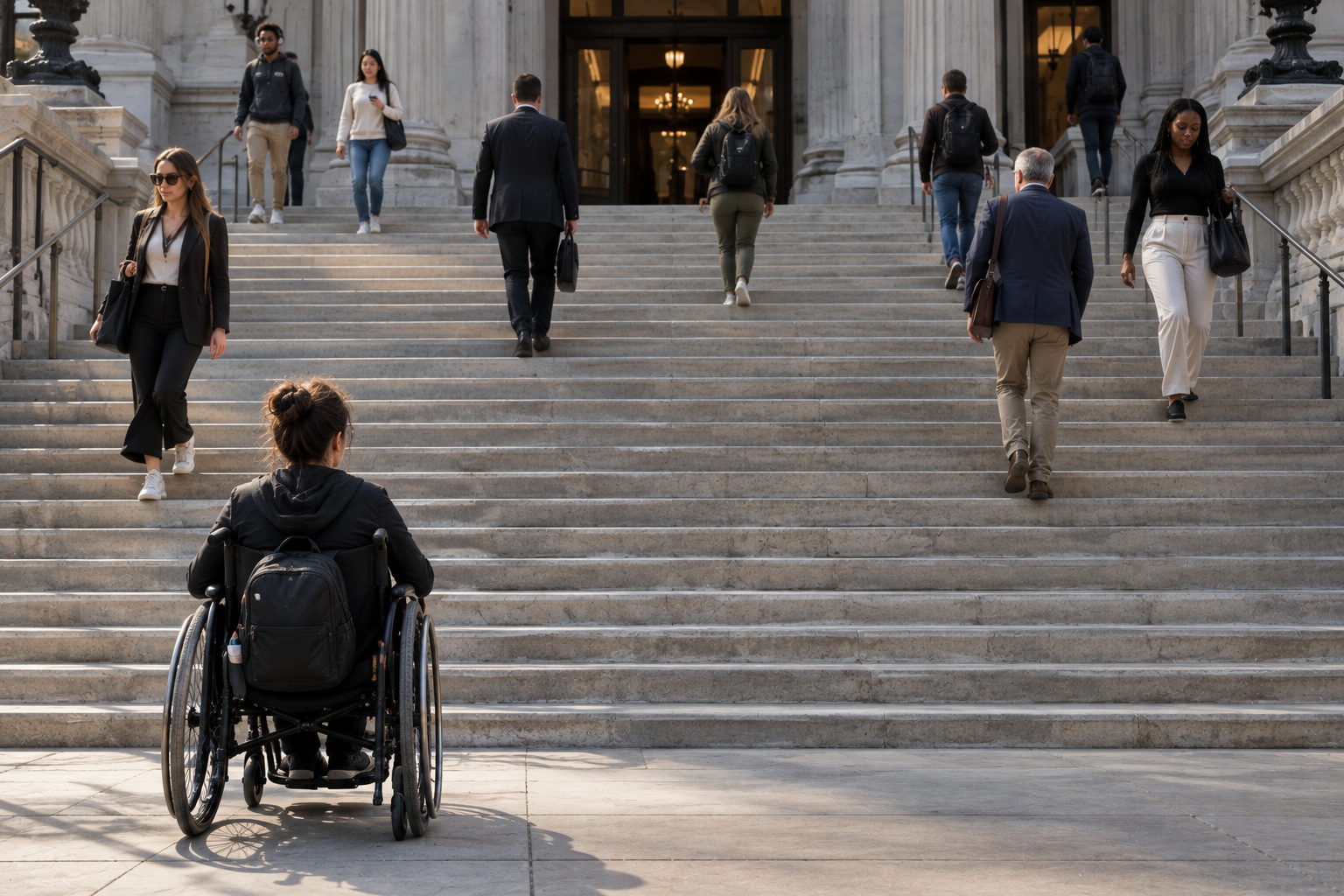
It’s also being excluded from places because they aren’t accessible. Accessibility problems aren’t just inconveniences when they happen repeatedly. Imagine being a wheelchair user and repeatedly arriving somewhere only to discover that there is no ramp or elevator. Imagine planning your day around whether a building has an accessible entrance, whether a bathroom can accommodate you, or whether transportation will actually be usable. Imagine being blind and navigating streets where sidewalks are poorly designed, crossings are dangerous, or the environment provides little reliable information about what is happening around you. Imagine having a sensory disability and repeatedly being expected to tolerate environments that overwhelm you because other people consider your needs inconvenient.

These experiences can create an ongoing sense that the world is not designed for you and that your safety, comfort, and participation are secondary concerns. When exclusion happens once, it can be frustrating. When it happens constantly, it can change how you experience the world.

The Damage of Being Othered

Disabled people are often treated as though they are fundamentally different from everyone else. Sometimes this is blatant, and sometimes it’s subtle. People may assume that a disabled person needs help without asking. They may assume someone can’t work, have relationships, raise children, live independently, make decisions, or pursue their goals. They may react with surprise when a disabled person does something completely ordinary.

There is another side to this, too: treating disabled people as inspirational simply for living their lives. A disabled person goes grocery shopping and someone acts as though they have accomplished something extraordinary. A disabled person gets a job and becomes a story about “overcoming adversity.” A disabled athlete, student, parent, or professional is presented primarily as an inspirational example rather than as a whole person.

This can sound positive, but it can still be dehumanizing. The underlying message can become: Your life exists to teach other people something. Disabled people don’t need to be inspirational simply for existing. They should be allowed to be ordinary human beings. They should be allowed to succeed, fail, struggle, rest, complain, have bad days, and pursue their goals without their disability becoming a lesson for everyone else.

Low Expectations Can Become Internalized

One of the most damaging things about constantly being underestimated is that eventually, you may start underestimating yourself. If you’re repeatedly told that something is too difficult for you, you may stop trying. If people constantly assume you need someone else to make decisions for you, you may begin questioning your own judgment. If you’re repeatedly treated as a burden, you may start believing that your needs are unreasonable.

This is one reason C-PTSD can involve such a complicated relationship with self-worth. The problem isn’t simply that other people have treated you badly. It’s that their messages can eventually become an internal voice. You may find yourself thinking:

  • I’m too much.
  • I’m a burden.
  • Nobody wants to deal with me.
  • I shouldn’t need this much help.
  • I should be able to handle this.
  • Maybe they’re right about me.

Healing means learning that those messages are not the truth.

Moving Toward Healing

Recovering from C-PTSD isn’t about forcing yourself to “get over” what happened. It’s also not about becoming so resilient that discrimination and exclusion stop hurting. Sometimes healing begins with something surprisingly simple: compassion for yourself.

Instead of asking, “What’s wrong with me?” try asking, “What happened to me, and how did it affect me?” Instead of criticizing yourself for needing accommodations, recognize that having needs does not make you weak or difficult. Instead of measuring your worth by productivity, independence, or what you accomplish despite your disability, begin recognizing that your worth exists independently of those things.

Building a stronger sense of self-worth can take time. It may mean discovering who you are outside of other people’s expectations. Your disability is part of your life, but it doesn’t have to define your entire identity.

Empowerment can also be an important part of healing. Learning your rights, asking for accommodations, setting boundaries, saying no, and advocating for yourself can help rebuild a sense of control. You don’t have to advocate every moment of every day, and you don’t have to fight every battle. Sometimes empowerment means choosing when to speak up, and sometimes it means choosing when to walk away and protect your energy.

Community matters, too. Being around people who understand your experiences without requiring you to constantly explain yourself can be incredibly healing. Disability communities can provide friendship, validation, humor, practical knowledge, and a sense of belonging that may have been missing elsewhere.

Professional mental-health support can also be valuable, particularly from someone who understands trauma and disability. You deserve a therapist who doesn’t treat your disability as the problem or assume that your goal should simply be to become more like a nondisabled person.

Ultimately, healing from C-PTSD isn’t about becoming unaffected by the world. It’s about learning that the things other people have said and done to you do not determine your worth. You are not a burden because you have needs. You are not less valuable because you need help. You do not have to inspire anyone. You do not have to prove that your life is worthwhile.

You are allowed to take up space. You are allowed to have boundaries. You are allowed to ask for what you need. You are allowed to be angry about injustice. You are allowed to rest. You are allowed to build a life that works for you.

And perhaps most importantly, you are allowed to see yourself as a whole person rather than as the collection of other people’s assumptions about disability. For someone living with C-PTSD, that realization can be an important part of coming home to yourself.


If you live in Washington State, and would like to set up an appointment with Susan Reimers, LICSW at Transcendent Mental Health, please click here.

Sun rays shining through dark storm clouds above green and brown mountains
Therapy

How to Cope With Panic Attacks Caused by Trauma and PTSD

Woman holding her head in stress at office desk with computer screens

Panic attacks can feel terrifying, especially when they are connected to unresolved trauma or Post-Traumatic Stress Disorder (PTSD). A racing heart, shortness of breath, dizziness, trembling, and overwhelming fear can make it feel as though something catastrophic is happening. For trauma survivors, panic attacks are often more than anxiety—they are the nervous system reacting to reminders of past danger.

Understanding how trauma-related panic works is an important first step toward healing. The good news is that there are effective treatments and coping strategies available, including therapy, medication, grounding exercises, and lifestyle interventions. With the right support, it is possible to reduce the intensity and frequency of panic attacks and regain a sense of control.

What Causes Panic Attacks in PTSD?

PTSD changes the brain and body’s stress response system. After experiencing trauma, the nervous system can become stuck in “survival mode.” This means the brain may interpret ordinary situations as threatening, even when there is no immediate danger.

Triggers for trauma-induced panic attacks can include:

  • Loud noises or crowded environments
  • Flashbacks or intrusive memories
  • Emotional conflict or relationship stress
  • Certain smells, sounds, or locations
  • Feeling trapped, powerless, or overwhelmed

When triggered, the body releases stress hormones like adrenaline and cortisol, activating the fight-or-flight response. The result can be intense physical and emotional symptoms that feel impossible to control in the moment.

Immediate Coping Strategies for Panic Attacks

1. Use Grounding Techniques

Grounding exercises help bring attention back to the present moment instead of the traumatic memory or fear response.

One of the most effective methods is the “5-4-3-2-1” grounding exercise:

  • 5 things you can see
  • 4 things you can touch
  • 3 things you can hear
  • 2 things you can smell
  • 1 thing you can taste

This technique helps interrupt the panic cycle and reminds the brain that you are safe right now.

2. Focus on Slow Breathing

Trauma-related panic attacks often cause rapid, shallow breathing, which can worsen dizziness and fear. Deep breathing exercises help regulate the nervous system and reduce physical symptoms of panic.

A simple method is box breathing:

  • Inhale for 4 seconds
  • Hold for 4 seconds
  • Exhale for 4 seconds
  • Pause for 4 seconds

Repeating this cycle for several minutes can calm the body’s stress response.

3. Challenge Catastrophic Thoughts

Panic attacks often come with frightening thoughts such as:

  • “I’m dying.”
  • “I’m losing control.”
  • “I’m not safe.”

While these thoughts feel real during panic, they are symptoms of the nervous system being overstimulated. Repeating calming statements like “This is a panic attack,” or “I have survived this before,” can help reduce fear and restore perspective.

4. Engage the Body

Trauma lives not only in the mind but also in the body. Gentle movement can help release nervous system tension during a panic attack.

Helpful physical interventions include:

  • Walking
  • Stretching
  • Progressive muscle relaxation
  • Holding ice cubes or splashing cold water on the face
  • Using a weighted blanket

These sensory experiences help reconnect the body to the present environment.

Best Therapies for PTSD and Panic Attacks

Professional mental health treatment is often essential for long-term healing. Several evidence-based therapies are highly effective for trauma-related panic.

Cognitive Behavioral Therapy (CBT)

CBT helps individuals identify negative thought patterns that fuel anxiety and panic attacks. It teaches practical coping skills and healthier ways to respond to triggers.

Eye Movement Desensitization and Reprocessing (EMDR)

EMDR is a trauma-focused therapy designed to help people process painful memories in a safer and less emotionally overwhelming way. Many PTSD survivors report significant reductions in panic symptoms after EMDR treatment.

Exposure Therapy

Exposure therapy gradually helps people confront triggers in controlled, supportive settings. Over time, this can retrain the brain to stop interpreting those triggers as dangerous.

Somatic Therapy

Somatic approaches focus on how trauma is stored physically in the body. Techniques involving breathwork, movement, and body awareness can help regulate the nervous system and reduce chronic hypervigilance.

Medication Options for Panic Attacks and PTSD

Medication can be an effective part of treatment, especially when panic attacks interfere with work, sleep, or daily functioning.

Common medications include:

  • Sertraline
  • Paroxetine
  • Fluoxetine

These antidepressants are often prescribed for both PTSD and panic disorder because they help regulate serotonin levels and reduce overall anxiety over time.

Some individuals may also benefit from short-term anti-anxiety medications such as:

  • Lorazepam
  • Clonazepam

These medications can reduce acute panic symptoms quickly but are generally used cautiously because of potential dependence risks.

For PTSD-related nightmares and sleep disturbances, medications like Prazosin may also help improve sleep quality and nighttime anxiety.

Medication decisions should always be made with a licensed healthcare provider who understands trauma and anxiety disorders.

Lifestyle Changes That Help Reduce Panic Attacks

Healing from trauma requires supporting the nervous system consistently, not just during moments of crisis. Important lifestyle habits include:

Prioritize Sleep

Poor sleep increases stress hormones and emotional reactivity. Creating a calming nighttime routine can help reduce panic vulnerability.

Limit Caffeine and Alcohol

Both substances can intensify anxiety symptoms and trigger panic attacks in sensitive individuals.

Practice Daily Mindfulness

Meditation, yoga, journaling, and mindfulness exercises can help retrain the brain to stay present rather than stuck in survival mode.

Build Safe Connections

Isolation often worsens PTSD symptoms. Supportive relationships, trauma-informed therapy, and support groups can provide emotional safety and validation.

Recovery Is Possible

Living with panic attacks caused by trauma or PTSD can feel exhausting and isolating, but healing is possible. Recovery does not mean never feeling anxious again. It means learning how to regulate the nervous system, process traumatic experiences safely, and regain confidence in your ability to cope.

Panic attacks are not signs of weakness. They are signs of a nervous system that has been overwhelmed and is trying to protect itself. With the right combination of coping strategies, therapy, lifestyle support, and medical care when needed, people can move from survival mode toward stability, safety, and healing.